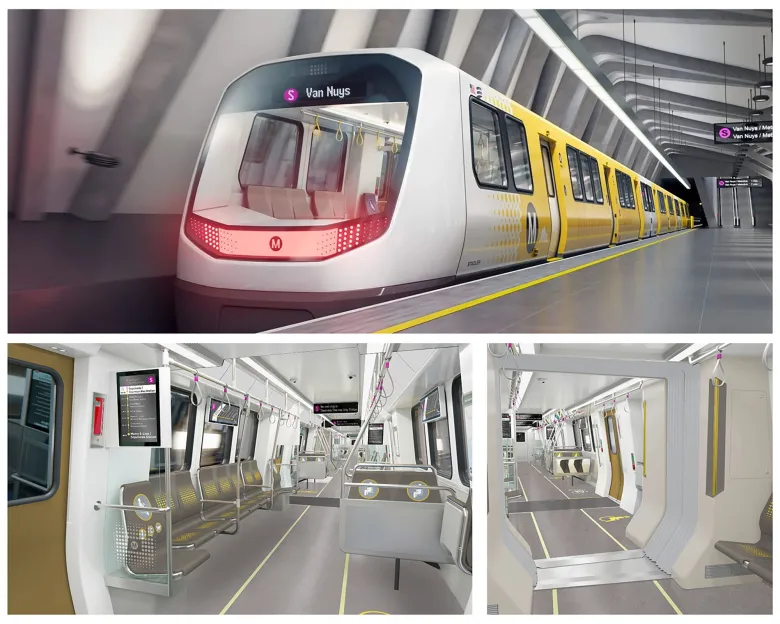
The historic vote sets in motion the first transit connection between two Los Angeles areas: The Westside and the San Fernando Valley.
By unanimous vote, the LA Metro Board on Thursday, Jan. 22, approved an underground rail project through the Sepulveda Pass, setting the stage for the first transit connection between two key Los Angeles areas: The Westside and the San Fernando Valley.
“It has been a long time coming. To be here today and see all the support for this project is very exciting,” said L.A. Mayor and LA Metro board member Karen Bass.
The only way residents can currently travel to and from these areas is via the 405 freeway through the Sepulveda Pass, the fourth most congested freeway in California, with trips taking 60 to 90 minutes each way. The proposed subway through the Santa Monica Mountains will establish a car-less alternative to the traffic-clogged 405 freeway.
A new route chosen from five laid out in the Environmental Impact Report, called the Modified Alternative 5, is fully underground starting in the north connecting with the Van Nuys Metrolink Station. It would run in a single-bore tunnel about 14 miles beneath Van Nuys Boulevard in the Valley, under the hills near Sherman Oaks and Bel Air, with a southern terminus at the Metro E (Expo) Line’s Sepulveda Station. The route includes stops at the G (Orange) Line, Ventura Boulevard, the UCLA Campus, the D (Purple) Line at Wilshire and Westwood and also the future East San Fernando Valley light-rail Line in Van Nuys.
Estimated time for an end-to-end ride is about 20 minutes or less.
The options for an elevated monorail mostly along the median or shoulder of the 405 freeway were rejected by the LA Metro Board. Elevated trains in the San Fernando Valley were also rejected.
“This is the right technology and the right alignment,” said L.A. City Councilmember and Metro board member Imelda Padilla, whose district represents the east San Fernando Valley.
A Sepulveda Pass transit project has been considered since 1980, when an early transit map showed an alignment from Sylmar to Long Beach, said Third District LA County Supervisor and Metro board member Lindsey Horvath. The Westside-to-San Fernando Valley project was listed in two transportation tax measures passed by county voters, Measure R in 2008 and Measure M in 2016.
“For more than 40 years, the Sepulveda Transit Corridor has been envisioned, studied, and reaffirmed by voters, but not yet delivered. Today’s action moves us closer to a real solution for one of the most congested corridors in the country,” Horvath said.
The project will carry as many as 124,000 daily riders, a little more than a fourth of the 400,000 daily vehicle trips that come through the Sepulveda Pass.
It is estimated at full ridership, the subway would reduce commute times through the pass by about 50%. The congested freeway today costs San Fernando Valley drivers about 59 hours per year.
Expected completion is between 2033 and 2036.
Metro estimates the project will cost $24.2 billion, but some put that figure even higher. Metro has set aside about $5.7 billion. The rest would have to come from federal and state grants.
L.A. City Councilmember and Metro board member Katy Yaroslavsky said she wants to see the project speeded up. “We all want this done in our lifetimes — hopefully sooner,” she said.
She said this project may be the most transformative transit project in the history of Los Angeles. While praising the route and concept, she was concerned about promising a project to the residents that Metro cannot afford. “While this is an important next step, it also raises the questions: How do we bring the cost down; how do we actually pay for it?”
Yaroslavsky amended the main motion to ask staff to hold community meetings for those living near Van Nuys Boulevard. She asked Metro to inform Bel Air residents about tunneling. Metro staff said the tunnels there would be 500 feet underground and all the construction would be underground as well.
Horvath was pleased to see the Sherman Oaks Homeowners Association support the project’s new alignment. She noted the group had been strongly opposed in the past, with concerns over vibrations from tunneling and high costs.
The group sent a letter in support of the chosen route, which it said uses “modern driverless heavy rail technology.”
Bob Anderson, vice president of the SOHA and transportation committee chair, said the new route was something his group suggested. However, he said some Bel Air residents are still concerned about the location of the underground tunnels. “This (route) is so much better than any of the three Metro had come up with,” he said in an interview.
He asked that Metro be more transparent about costs, project schedule and funding options.
Bass said she had recently spoken to some Bel Air homeowners who were concerned about tunneling in the area. But she said in an earthquake, being under ground is a safer place than above ground.
The chosen alignment does not stop at the Getty Center. Bass wanted a report back from staff in four months on planning for roadway connections to the museum from the nearest train station.
Almost all the commenters who spoke approved of the project and the chosen alignment. Many of those came from UCLA, who were happy that the project plans a fully underground station at UCLA.
“This project will serve the San Fernando Valley and the biggest economic engine in western half of the county — and that is UCLA,” said Coby King, who represents a group of supporters from UCLA and the Westside who supported a UCLA station. Each day, 86,000 students, faculty, staff, and visitors travel to the UCLA campus.
Diego Bollo, UCLA undergraduate student body president, thanked the board for including a station on the UCLA campus.
“It’s really important to making our university accessible to all parts of Los Angeles,” he said. “When UCLA is strong, L.A. is strong.”
Pam O’Connor, former mayor of Santa Monica and ex-LA Metro board member, said the Sepulveda Pass line will not just bring Los Angeles together, but will have a regional outreach, due to the connection with the Van Nuys Metrolink Station which includes a train that goes out west to Ventura County.
“It is going to have significance for LA County but also regional significance by feeding into Ventura County,” she said in an interview after the vote. “I think this is such an important project.”